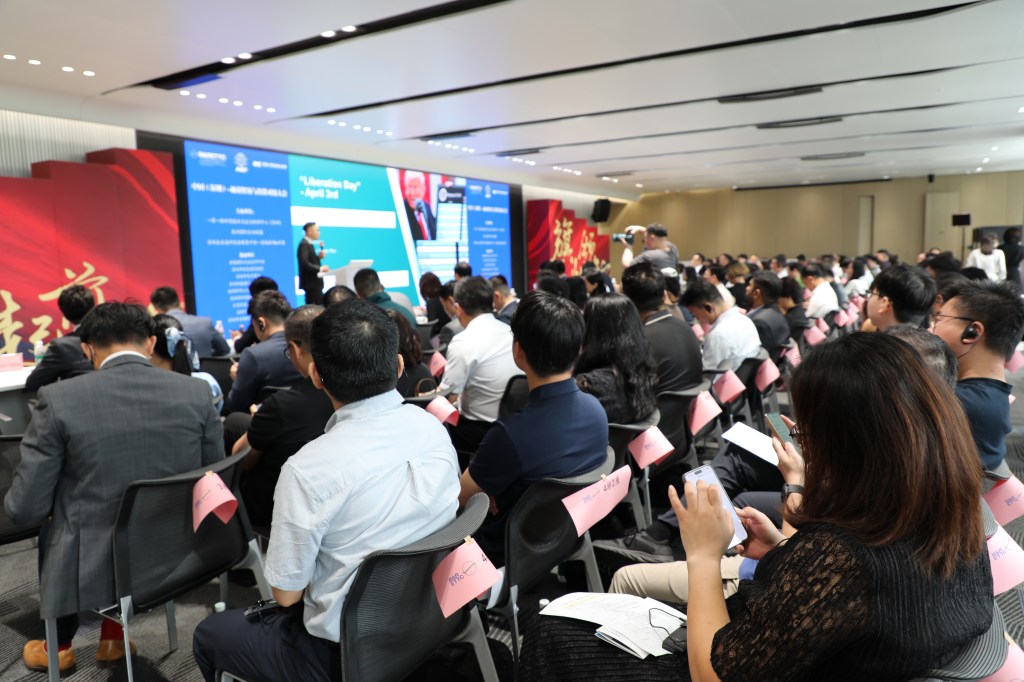
(Dalat, Vietnam) — Today marks my third consecutive Thursday not staying in HCMC. Two weeks ago, I was in Hanoi for the visa preparation, last week in Shenzhen for the talk, and this week, on my way to relieve from the event. Given my sleep disruption during travel, plus the #tbt vibe, it’s time we discussed “Why Vietnam?” again.
First of all, trade war is real. It is happening and affecting all of us, in both short term and long term. People might say “oh well it’s just a storm, be careful, be bold”. It might look like just a storm, but do not forget there is also a so-called climate change.
For much of the world, what we call the “trade war” has been dramatized through headlines of tariffs, sanctions, and political posturing — often personified by iconic images like President Trump on April 3rd — his “Liberation Day”. But beneath the surface noise lies a deeper, more permanent transformation. What began as a bilateral spat in 2018 has evolved into a global reordering of trade logic — not just about the flow of goods, but about technology sovereignty, capital security, and ideological trust. The real shift is not the tariffs; it’s the architecture of the global economy itself, now entering a long phase of division and recalibration.
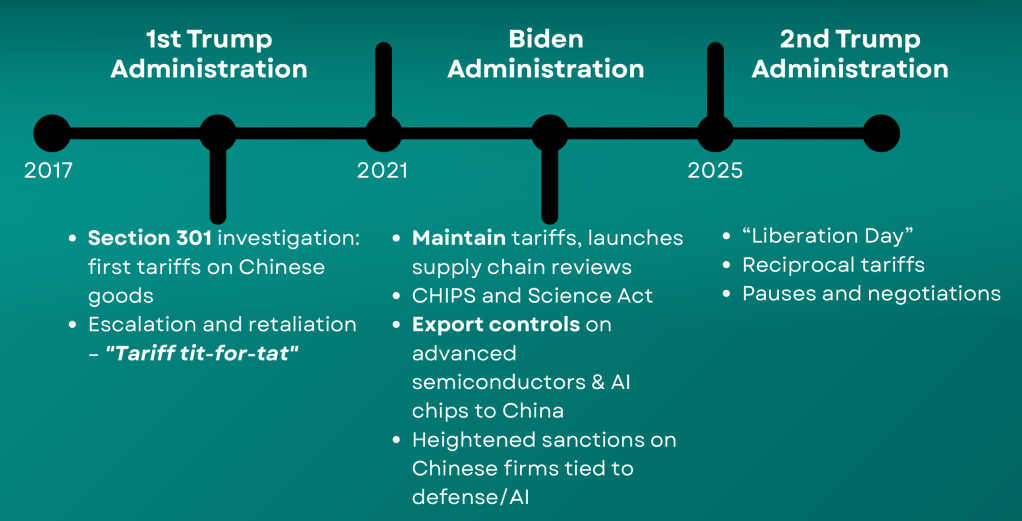
Let’s take 2018 as the starting point – where Trump administration announced Section 301 investigation, imposing 10-25% tariffs on $50B of Chinese goods, then quickly expanding to $250B of total Chinese imports. China retaliated with those on roughly $110 billion of U.S. goods later that year. Optimists was waiting for the ending of Trump administration, as many are doing right now in his second term, and hoped that things would be de-escalate and back to “normal”. It is funny that, at the last months of Trump first term, we all learnt the phrase “the new normal”, taught by a very well known virus.
What was happening during Biden administration then was a hard-hit to those high expectations. The US maintained the tariffs, even added more reviews and announced what’s called “small yard – high fence” approach – which is to place strict restrictions on a small number of technologies with significant military potential while maintaining normal economic exchange in other areas, notably named CHIPS and Science Act. It turned out that, despite having different approaches and were described very contrasting on the news, the two administrations has had the same view on China issue, which considered China no longer a partner but a (dangerous) competitor. The differences are that, Biden was forming allies to corner China, while Trump kept threatening all countries over the world and forcing them to choose side – US over China. Personally, I feel like China would prefer Trump to Biden, as Biden was more stick to his “standards” – democracy, while Trump has been (only) a “deal maker”.
Last month I was attending a seminar organized by Nikkei Asia, where I heard Dr. Alexis Crow from PwC separate trade war into three distinct but overlapping layers: Goods, Technology, and Capital flows. The first layer – Goods – has always been “emotional”, loud, but negotiable. If trade war(s) was ever only war on this layer, there would be no significant shift in the long run, and if any, that would very likely reversible. However, real life trade war contained Tech layer – which is now increasingly tied to national security and innovation dominance, and thus almost non-negotiable, as highlighted during Biden administration. The third is Capital flows — often overlooked, but already in motion; from supply chains to investment policies, financial capital is quietly migrating to more aligned, risk-mitigated zones. Unlike tariffs, which can be reversed by a signature, or more frequently a tweet on Truth Social, the two deeper layers reflect structural rethinking — and no administration, whether Trump or Biden, has shown signs of reversing course.
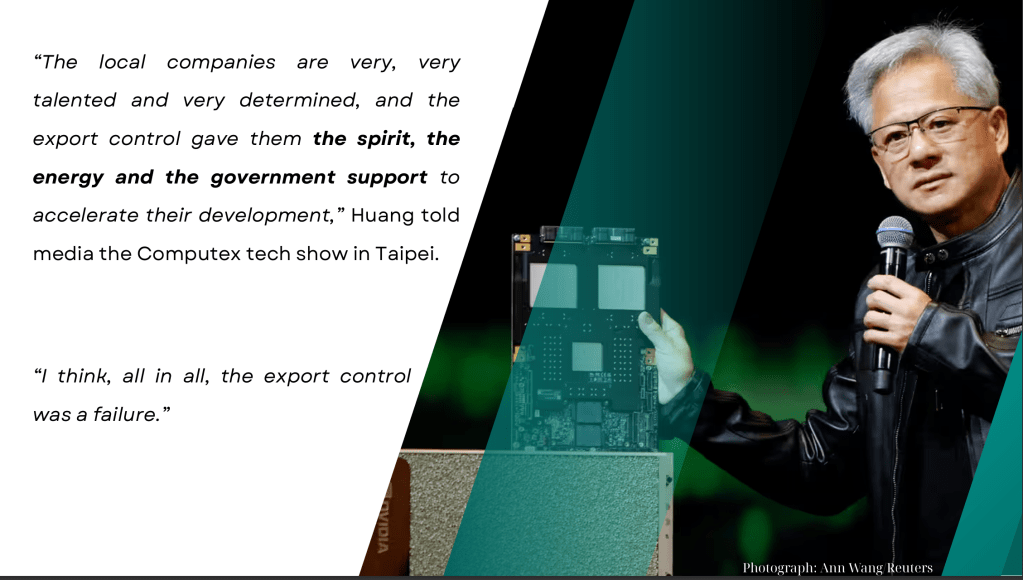
Additionally, China now is not China we knew before 2018. Thanks to the US who was placing China in the gym with tough exercises and weights, China has thrived into a real superpower in future tech and even leading the world in some areas. This recalled my Israel Arab friend, Nashwa, story: As the Jews restrict Arab in some certain areas, either disallow Arab students to study in “sensitive” fields or raising the qualified scores applied to Arabs, they have patiently overcome such inequalities and now most top scientists/ engineers/ researchers in some key industries (e.g. medical) are Arabs. Chinese story is much longer, complex yet inspirational. Here, I will only quote Jensen Huang last week comment on Chinese chip industry.
The world has become too small for two superpowers somehow of the same level. Global supply chains are shifting from “just‑in‑time” efficiency to “just‑in‑case” resilience. Before 2018, all talked about efficiency: low cost, high speed, free trade, FTAs, WTO, globalization. Now, within the divided world economy of extreme uncertainty, we embrace resilience, risk mitigation, redundancy. Supply chains are re-routing not just for profit, but for politics. Trust, proximity, and ideological compatibility are the new currencies of global trade. In this context, economies like Vietnam are no longer just participants — they are becoming essential gateways.

Among all new emerging destinations, Vietnam has chosen its own way — bamboo diplomacy. There were arguments on this approach, saying that as belong to no alliances, we would not be close enough to any superpower thus get nothing eventually. However, look at what has happened recently, we see a different story:
- Liberation Day: President Trump imposed 46% reciprocal tariffs on Vietnam
- Late April 4th: General Secretary To Lam holds phone conversation with President Donald Trump
- April 14th: President Xi Jinping arrived in Hanoi as his first destination since April 3rd
- April 15th: “I don’t blame China; I don’t blame Vietnam,” President Trump told reporters at the White House. “That’s a lovely meeting. Meeting like, trying to figure out: ‘How do we screw the United States of America?’”
- May 21st: Eric Trump spoke at the groundbreaking ceremony for Trump International Hung Yen – together with PM Pham Minh Chinh. Days later, he visited HCMC for IFC discussions.
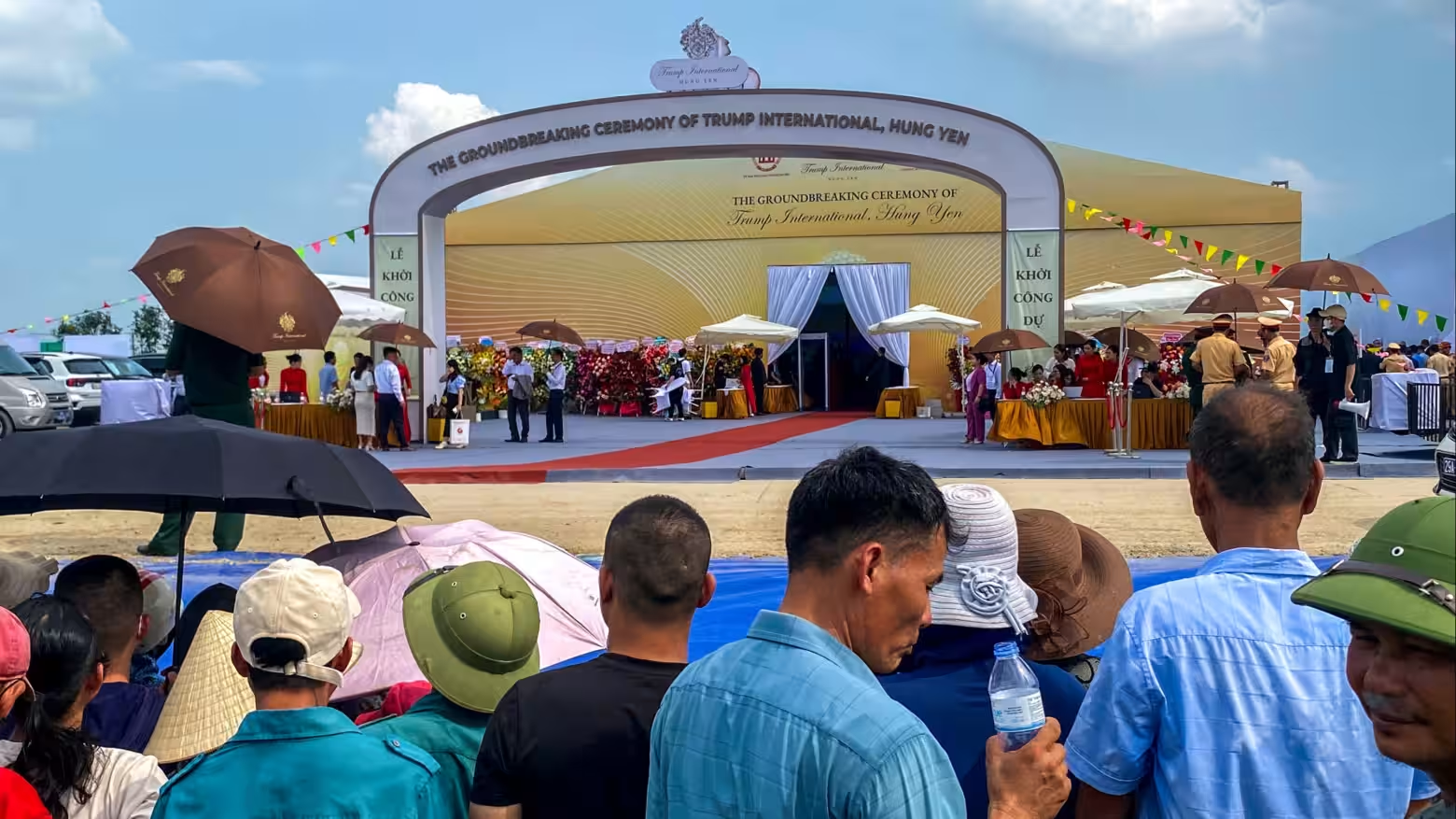
It shows, when the stakes demand, Vietnam has all the cards to respond quickly and effectively, which is allowed by the one-party governance. As for a President of deal-making style, this direct and decisive approach together with good timing would have great influence on tariff negotiations. Fallout and deflect domestic backlash might occur, as in any land-use projects, but all is under control and within calculations. The unrivaled advantage of Vietnam in this trade war context is simple as that, yet hardly any countries can afford to follow: The powerful and absolutely unified governance together with its aggressively pro-growth policies – defining sustained economic growth as the overriding political priority.
Vietnam does not seek to become a battlefield in the ongoing trade war. We are not — and will not be — a competitor to either superpower. Frankly, we cannot and should not aim to become a second China. Instead, Vietnam’s long-standing bamboo diplomacy and recent strategic moves reflect a clear aspiration: to serve as a gateway between two worlds. For US companies seeking a China+1 strategy, and for Chinese enterprises looking to reach Western markets, Vietnam offers both proximity and neutrality. The path ahead remains uncertain, with intense global competition and shifting alliances — but sustaining this positioning would not only benefit Vietnam, it could also bring long-term strategic value to both the US and Chinese economies.
 MIDDLEARCH
Leave a comment